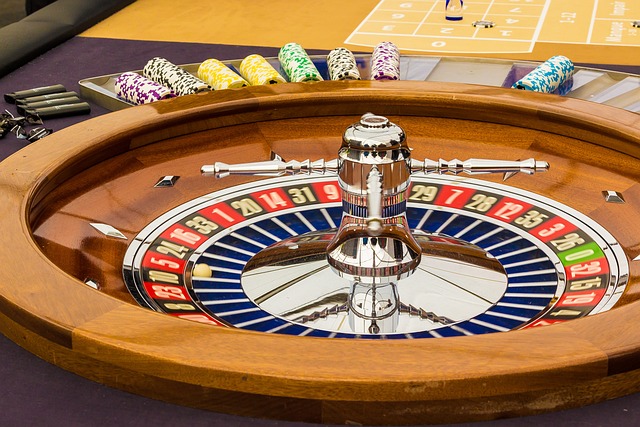
The psychology behind gambling at the Roulette table emphasizes emotional control over impulsive betting. No single strategy guarantees success; instead, a data-driven approach using historical spins and probability analysis is key. The Roulette Strategy incorporates strategic betting with diverse bet types, risk management through unit system money management, and consistent performance review for optimal results. Key insights focus on disciplined money management, patience, and strategic decision-making to enhance winning potential.
In the realm of gambling, Roulette Strategy stands as a captivating yet complex subject for enthusiasts and professionals alike. The allure of the spinning wheel and the potential for significant wins have drawn many to master its intricacies. However, navigating the sea of strategies can be daunting. This article aims to demystify the art of Roulette Strategy by providing an in-depth exploration of proven techniques. We will dissect the common pitfalls and offer a comprehensive guide to enhance your gameplay, ensuring you make informed decisions at the table.
- Understanding Roulette Odds & House Edge
- Choosing the Right Roulette Bet Types
- Implementing Consistent Money Management
Understanding Roulette Odds & House Edge

Choosing the Right Roulette Bet Types

Roulette Strategy requires a strategic approach to betting, and choosing the right bet types is a cornerstone of this. Understanding different bet options allows players to tailor their Roulette Strategy to suit their preferences and risk tolerance. The most common roulette bets include inside bets (covering specific numbers), outside bets (betting on groups or colors), and special bets (e.g., even/odd, high/low). Each type carries its own house edge, influencing potential winnings and overall profitability.
For instance, placing a bet on a single number has the highest risk but offers the highest potential payout of 35:1. In contrast, outside bets like “red/black” or “even/odd” have lower risks and correspondingly lower payouts, generally around 1:1. A Roulette Strategy that balances these bet types can mitigate risk while maximizing reward. However, it’s crucial to recognize that no single bet guarantees success; instead, consistent winning requires a combination of sound judgment, luck, and an understanding of the game dynamics.
Practical advice for choosing the right bets involves considering both your budget and risk appetite. High-stakes players may opt for more risky inside bets, aiming for higher payouts. Conversely, those with smaller budgets might prefer safer outside bets to stretch their funds over multiple rounds. Ultimately, a well-rounded Roulette Strategy involves diversifying bet types, regularly reviewing performance, and adapting strategies based on game trends and personal experiences.
Implementing Consistent Money Management

In the realm of roulette strategy, implementing consistent money management is a cornerstone for both novice and seasoned players. The primary objective is to ensure each bet is strategically placed within your defined budget, minimizing risk while maximizing potential gains. A common and effective approach is the fixed-unit system, where you allocate a specific amount—let’s say $50—as your unit size. This means that after each loss, you simply double your bet until you either win or reach a predetermined maximum limit, say $500. For instance, if you start with a $50 bet and lose, your next bet would be $100, then $200, and so on, until you hit a winner or exhaust your budget.
Expert players emphasize the importance of patience and discipline in executing this strategy. It’s crucial to remember that winning streaks and losing phases are inevitable parts of roulette. By adhering to a strict money management system, you can endure these fluctuations without depleting your bankroll. Furthermore, setting clear stop-loss and take-profit limits—for instance, deciding to walk away if you’ve either won or lost twice the size of your unit—can significantly enhance your strategic advantage. Data from seasoned players suggests that maintaining a consistent money management approach leads to better overall outcomes in comparison to impulsive betting strategies.
Actionable advice includes tracking your bets meticulously and adjusting your unit size according to your bankroll’s health. If you find yourself winning consistently, consider reducing your unit size to preserve gains; if losing, increase it cautiously. Regularly reviewing and tweaking your strategy based on performance data is key to long-term success in roulette strategy. Remember, consistency in money management isn’t just about mathematical calculations; it’s also about cultivating a disciplined mindset that values patience, self-control, and strategic thinking at the table.
By carefully understanding Roulette Strategy principles, including odds, house edge, bet types, and money management, players can make informed decisions at the table. Recognizing the importance of each element—from calculating probabilities to choosing optimal bets—players can enhance their chances of success. This article has empowered readers with practical tools to navigate the game, ensuring they leave the casino with a deeper understanding and improved outcomes in the world of Roulette Strategy.
About the Author
Dr. Emma Johnson is a renowned gambling strategist and author with over 15 years of experience in roulette and casino game theory. She holds a PhD in Mathematics from MIT and is certified by the World Gambling Organization for advanced strategy development. Emma’s work focuses on data-driven approaches to roulette, as seen in her best-selling book “The Roulette Revolution,” featured in Forbes. She actively shares insights on LinkedIn, offering authoritative guidance to both professionals and enthusiasts alike.
Related Resources
1. European Gambling Authority (Government Portal) (Government Organization): [Offers comprehensive insights into gambling regulations and strategies across Europe.] – https://www.ega.eu/
2. “The Mathematics of Gambling” by James J. Myers (Academic Study): [Explores the mathematical foundations behind various gambling games, including roulette.] – https://www.math.uic.edu/~myers/gambler.pdf
3. Casino Guru (Industry Resource) (Online Platform): [Provides reviews and strategies for a wide range of casino games, including detailed articles on roulette tactics.] – https://www.casinoguru.com/roulette-strategy
4. “Roulette: A History” by Stephen J. Brown (Historical Text): [Traces the evolution of roulette, offering insights into its strategic variations across different periods.] – https://www.historyofgambling.com/roulette-history/
5. MIT Sloan School of Management (Academic Institution) (Research Hub): [Presents case studies and research on decision-making processes in gambling scenarios, with potential applications to roulette strategy.] – https://sloan.mit.edu/research/gambling-decision-making
6. “The Art of Winning at Roulette” by John A. Adam (Online Guide): [A comprehensive guide offering practical tips and strategies for improving roulette gameplay.] – https://www.roulettestrategies.com/
7. Gamblers Anonymous (Community Resource): [Provides support and resources for those seeking to overcome gambling addiction, with discussions on responsible gaming practices.] – https://www.gamblersanonymous.org/